

Tours
Slovenia, part II: Hemingway, Soča and other reasons to fall in love with Slovenia. 109 years later
Oct 22, 2026
UP THE MOUNTAINS · SLOVENIA, PART II · SEPTEMBER 2026
In the first part of our diary, we told you about Logarska Dolina and the reasons why we believe it is one of the most beautiful valleys in the Alps. We know, it's a bold statement, but we take it on. :) Next, let's tell you about Soča. The valley that has it all: water, ridges, peace, civilization, gastronomy and a history that, a little over a century ago, was anything but peaceful.
So we continued towards western Slovenia, with a stop at Bohinj, unfortunately too short. It's clear that we're coming back, especially since it's also the 7 lakes circuit - get info from here and say a phrase Triglav Lakes Valley (Seven Lakes Valley) Day Hike, Slovenia
Bohinj. The wilder brother of the famous Bled
After four nights in Logarska Dolina, we headed west. Lake Bohinj greeted us with low clouds, rain, and mountains hidden in mist. It wasn't exactly ideal weather, but it had that alpine atmosphere that we love.
And, after all, if the mountains were only beautiful in the sun, we would have a pretty big problem. Bohinj is the largest permanent natural lake in Slovenia and is located in the Triglav National Park. Unlike the much more famous Bled, where tourism is very present, Bohinj has preserved a quieter and closer to nature atmosphere. We like it more and we highly recommend it. Here also begins one of the most spectacular mountain regions of the country.
From the lakeside you can set off towards alpine pastures, glacial lakes and, for the well-prepared, towards Triglav, Slovenia's highest peak, at 2,864 m. - see here Triglav Lakes Valley (Seven Lakes Valley) Day Hike, SloveniaTriglav even appears on the country's flag. Slovenians have a special relationship with this mountain and there is a popular tradition according to which every Slovenian should climb its peak at least once in their life. For now, we settled for a photo next to Zlatorog, the legendary golden-horned goat, one of the symbols of the Julian Alps. According to legend, Zlatorog guarded a treasure hidden in the mountains. A greedy hunter tried to kill him, but miraculous flowers grew from the animal's blood that healed him. There's no point in telling you that we don't like hunters and that we don't welcome them on our tours. :) So I took a photo with our cousin Zlatorog.
We also discovered a few villages around the lake, with traditional houses, haylofts and old churches. Bohinj has a very interesting pastoral culture, linked to alpine sheepfolds and cheese production. One of the specialties is Bohinjski mohant, a cheese with a protected designation of origin and a taste that we can diplomatically say does not go unnoticed. We were only passing through, but Bohinj is worth a few days.
Over Vršič, towards the river that gave its name to a front

We continued to Kranjska Gora and then over the Vršič Pass, at 1,611 meters, the highest road pass in Slovenia. The road has 50 numbered switchbacks and crosses a spectacular area of the Julian Alps. It is one of those roads where passengers admire the scenery, and the driver has other concerns. It is a wonderful road for motorcyclists even if there are areas where the road has no asphalt but cubic stones which can become problematic in the rain. Vršič also has a disturbing story.
During World War I, the road was built using forced labor from Russian prisoners. In 1916, an avalanche killed many prisoners and soldiers, and in memory of the victims, the Russian Chapel, a small wooden Orthodox church, was built. We then descended to Trenta and began to follow the course of the Soča River. And what a river! It is currently in 1st, 2nd and 3rd place in our top of rivers. It sits comfortably on 4th (says a river here in Romania that has potential). The water has an almost unbelievable color, somewhere between turquoise and emerald green (between precious stone and make an appropriate and funny comparison).
Sometimes it flows quietly through forests, other times it slithers through deep gorges, between limestone walls. The Soča rises in the Julian Alps and continues into Italy, where it is called the Isonzo. Today it is famous for rafting, kayaking, fishing and hiking. However, 109 years ago, the name Isonzo was associated with one of the bloodiest fronts of the First World War.
Kobarid. Hemingway, Caporetto and the mountains that have seen too much
Kobarid is today a quiet town, with neat houses, good restaurants and spectacular mountains all around. In October 1917, however, its Italian name, Caporetto, would go down in history. Between 1915 and 1917, the Italian and Austro-Hungarian armies fought twelve battles along the Isonzo River. The battles took place at altitudes of over 2,000 meters, on ridges, on limestone walls and in terrible weather conditions. The soldiers carried ammunition, food and equipment up the slopes that today we climb with technical boots, trekking poles and high-performance backpacks.
Many of today's trails follow old military routes or pass by front-line positions. The traces are everywhere: casemates, trenches, tunnels and supply routes. In October 1917, an Austro-Hungarian and German offensive broke through the Italian front in the Caporetto area. The retreat that followed turned into a military disaster, and in Italian the word Caporetto has become synonymous with a catastrophic defeat.
This is where the connection with Ernest Hemingway comes from. The American writer did not participate in the 1917 battle. He arrived in Italy in 1918 as a volunteer for the American Red Cross, and was wounded on the Italian front. But his experiences and accounts of the retreat from Caporetto inspired the novel A Farewell to Arms, published in 1929. So when we say we followed in Hemingway's footsteps, we are referring to the places in the geography of his novel, not to a route that the writer would have taken during the battle.
The Museum in Kobarid. A visit we recommend without reservation

We started our exploration of the city with the Museum in Kobarid, dedicated to the Isonzo Front. We love history. We did the same in the Dolomites, where the First World War left impressive traces. So it was natural to start the day with the museum. It is not a museum that tries to glorify the war. Quite the opposite. Through photographs, letters, personal items, maps and testimonies, it manages to show how absurd and tragic the life of the soldiers in these mountains was. And then you leave the museum, look at the landscape and start to see everything with different eyes.
We also liked Kobarid as a town: it is small, green, nestled between mountains, and has that mix of alpine atmosphere and Italian influence that makes the region so interesting. Because many of the roads and paths that tourists walk on today were once military supply routes. On the ridges that we take photos on today, there were artillery positions and trenches. The mountains are just as beautiful. Only the people have, fortunately, other concerns.
The historical circuit of Kobarid. 10 kilometers between war, antiquity and one of the most beautiful waterfalls in Slovenia
Distance traveled~10 kmCumulative climb+600 m Type Circuit Kobarid Historical Trail. After the museum we set off on the historical trail in Kobarid, which we traveled in an extended version, of approximately 10 kilometers and 600 meters of positive elevation gain. It was one of the most interesting days of the trip, because we combined a real hike with history, archaeology and some spectacular natural places. The first important stop was the Italian ossuary, built on the Gradič hill, around the church of Saint Anthony.
Here lie the remains of over 7,000 Italian soldiers who fell in the battles in the region. The monument was inaugurated in 1938, during the Mussolini era. It is imposing, but what impresses most is the tranquility of the place and the contrast with what happened here a century ago.
We then continued through the forest to Tonocov grad, an archaeological site located on a rocky hill above the Soča River. Here comes a surprise: long before World War I, the place was already used as a fortified settlement. Archaeologists have discovered vestiges from Late Antiquity, including ruins of Paleo-Christian churches. In other words, the same strategic place was important to people over a thousand years later. Further on, the trail passes near former Italian military positions, trenches and fortifications. Some have been almost completely swallowed up by the forest. Trees grow between the walls, roots penetrate the structures, and moss covers the stones.
We obviously entered the places where access was allowed. We are curious and we like history, I told you. :)In these places, nature seems to have finally won the war.
Kozjak Waterfall. The spectacle at the end of the trail
One of the most beautiful stops on the circuit was the Kozjak waterfall. It is not the highest waterfall in Slovenia. It is about 15 meters high. But it is probably one of the most spectacular. The Kozjak stream has carved a narrow gorge in the limestone, and at the end of it the water falls into an emerald-green pool, surrounded by high rock walls. It is very beautiful without exaggeration. You pay an entrance fee but it is well worth it.
The place resembles a roofless cave, lit by an opening high above the water. And the journey there is part of the experience. The trail initially follows the Soča River valley, then enters the gorge of the Kozjak stream. You pass through the forest, past moss-covered rocks, over footbridges and, in the last part, on wooden walkways suspended above the water. And at the end, Kozjak appears. It is one of those places that look spectacular in photos, but are even more beautiful in reality.
The waterfall can also be accessed separately, via a much shorter walk from the parking lot near Kamp Lazar. We have integrated it into the historical circuit, which we recommend to those who want to discover more than the objective itself. After about 10 kilometers and 600 meters of climbing in total, we returned to Kobarid with the feeling that we had made one of the most successful cultural hikes of the trip. We also returned over the Napoleon Bridge, which crosses the Soča at a point where the turquoise water flows between the rock walls.
The name is reminiscent of the old bridge used during the Napoleonic era; the current structure was rebuilt after the destruction of World War I. And perhaps this is one of the things we love most about Slovenia: you don't have to choose between nature and history. You can often find both on the same trail.
Drežnica. The village that should be on the cover of Slovenia guidebooks
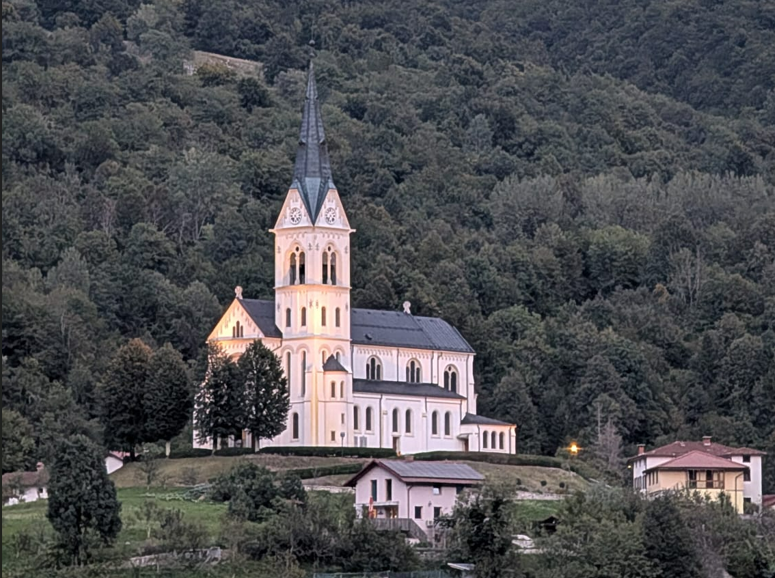
Another day we went to Drežnica, a village perched on a green terrace at the foot of the Krn massif. And here we have to admit something: if someone asked us which was the most beautiful village we had seen in Slovenia, Drežnica would have a very good chance of winning.
It has everything: sprawling houses, green meadows, a spectacular church and huge mountains rising almost vertically in the background. The Church of the Sacred Heart of Jesus seems almost disproportionately large for such a small village. But that's exactly what makes it so photogenic. And, unlike many alpine villages that have become famous tourist destinations, Drežnica seems to have preserved its ordinary life. During the First World War, the area was very close to the front line, and the Krn massif was the scene of terrible battles. (also says about krn what does it mean and what altitude it has) we didn't get to it now but will next time. also says about kosek gorge 7 Best Things to Do in Kobarid, Slovenia that he missed now.
Today is, fortunately, an excellent starting point for hiking. Which is what we did.
Krasji vrh. 12 kilometers, a thousand meters climbed and a mountain worth discovering
Distance traveled~12 km Cumulative ascent+1,000 m Maximum altitude 1,770 m.
We chose to climb Krasji vrh, the highest peak of the Polovnik ridge, with an altitude of about 1,773 meters. It is not a famous mountain like Triglav and not one of the highest in the Julian Alps. But it has something that we really appreciate: an excellent position for panoramas and much less crowding than the classic routes. They say that knr is the boss of the peaks there but it will be left for next time.
We started from the Drežniške Ravne area, at about 750 meters above sea level, and started climbing through the forest. And we kept climbing. In about five kilometers we gained over a thousand meters of altitude, which means a sustained climb, without too many moments when you get bored. After we left the forest, the landscape opened up to the Krn massif and the peaks of the southern Julian Alps. Here too, the traces of war are numerous: old military positions, supply routes and fortifications that remind us of how contested these peaks were. Krn, with its 2,244 meters, dominates the region. During the First World War, the mountain was one of the important positions of the Isonzo front, and the battles fought here remained among the most dramatic episodes of the Alpine war.
From Krasji vrh you have a very good perspective of the entire area. You understand why these peaks were strategically important, but also how difficult it must have been to defend or conquer them. On clear days, the views extend to the Soča Valley and numerous peaks of the Julian Alps.
We covered a total of approximately 12 kilometers, with a positive elevation gain of 1,000 meters. It is a medium difficulty trail, but it requires good physical condition, especially because of the concentrated climb over a relatively short distance. And it is exactly the kind of hike we like: no crowds, no tourist facilities at every step and with a worthy reward at the end.
Free ice cream. An unexpected benefit of UIMLA certification
After the shift, we arrived at an ice cream parlor where you could prepare your own portion of ice cream.
After climbing a thousand meters, it seemed like an excellent idea. But the surprise came when the owner noticed the UIMLA badge we were wearing. He recognized it, learned that we were internationally accredited mountain leaders, and offered us free ice cream.
We don't know if this benefit is provided for in the UIMLA standard, but we think it would be worth introducing. :)Just kidding, we were happy to see that our international certification is also recognized in a small village in Slovenia. And that, sometimes, it comes with dessert.
Robidišče. Four nights at the end of Slovenia
For the four nights spent in the region, we chose Rest & Ride, an accommodation in Robidišče, the westernmost village of Slovenia.
It is a small, isolated village, surrounded by forests and hills, just a few steps from Italy. After the alpine atmosphere of Lenar Farm, we discovered a more rural, secluded and equally interesting Slovenia here. Nearby is the Nadiža River, known for its clear water and natural bathing spots.
Also here is one of the two bridges called Napoleon's Bridge in the region. The most famous is the one in Kobarid, built over the Soča, above a spectacular gorge. The second crosses the Nadiža, near Podbela, and is a stone bridge with a single arch.
We especially liked the latter. It is less famous, more secluded and set in a very beautiful natural setting. Sometimes small places are better remembered than big attractions.
Kobarid. From traditional food to three Michelin stars
Slovenia also pleasantly surprised us when it came to food.
The cuisine of the Soča Valley combines Alpine and Italian influences and uses many locally produced ingredients. Worth trying are frika, a simple dish of potatoes and cheese, fried together, and kobariški štruklji, the traditional dessert from Kobarid, filled with walnuts and other ingredients. But the region also has a gastronomic surprise of great proportions.
A few kilometers from Kobarid, in Staro Selo, is Hiša Franko, the restaurant run by Ana Roš, awarded three Michelin stars. Ana Roš has become famous for the way she transformed local ingredients and culinary traditions into a world-class gastronomic experience.
And what we find extraordinary is that the restaurant is not located in a European capital, but in a village in an Alpine valley. We didn't get to eat there, because we didn't have time. Let's not talk about money. :)
But we like the idea that in the same region you can find a traditional sheepfold, a cheese-making farm, and a three-Michelin-star restaurant. And that all of these are part of the same gastronomic culture.
Last evening in Italy. Cividale del Friuli and the Devil's Bridge
On the last evening we decided to cross the border into Italy, to Cividale del Friuli.
And I did very well. Cividale is a small Italian town with narrow streets, historic buildings, small squares and an atmosphere where no one seems to be in a hurry. It was founded in the Roman period, and later became one of the most important centers of the Lombards. Its monuments from this period are now part of the UNESCO heritage.
The most spectacular place is Ponte del Diavolo, the Devil's Bridge, built over the Natisone River. Legend has it that the locals asked the devil for help in building the bridge, and he agreed on the condition that he would receive the soul of the first being to cross it. However, the people were smarter and sent an animal first. We don't know how pleased the devil was with the result, but the bridge turned out very well.
We walked through the historic center and enjoyed the Italian atmosphere. A very nice ending to the four days spent in the Soča Valley.
What we didn't get to see. And why we already have reasons to come back

In eight days in Slovenia, I saw a lot. But inevitably there were places I didn't have time for. First of all, the Valley of the Seven Lakes in Triglav National Park, one of the most spectacular alpine areas in the country.
We did a lot of research before we left, including Moon & Honey Travel, a site we recommend to those looking for detailed descriptions of hikes in the Alps. The Valley of the Seven Lakes is a high-altitude glacial landscape with lakes, huts, and limestone walls. It can be explored on a long day hike or, even better, with a night spent at a hut.
The Mangart area, other trails in the Krn massif, and a few villages that we passed through without having time to stop are still on the list. But maybe it's better this way. We already have reasons to come back.
Slovenia. A small country with big lessons
After eight days spent in Slovenia, I was left with the impression that I had discovered one of the most beautiful mountainous countries in Europe.
Not just for the landscapes. Although, in this chapter, Slovenia is extraordinary. But also for the way it has managed to maintain a natural relationship between people, nature and tourism. I saw well-kept villages, traditional farms, well-marked trails, mountain huts, interesting museums and places where history is explained and respected.
We saw that you can develop tourism without turning every valley into an amusement park. And we often thought about our Carpathians. We have mountains that are just as beautiful, maybe even wilder in many places. We have authentic villages, traditions and extraordinary landscapes. What we can learn from the Slovenians is how all of this can be valued, with care and respect for the places.
It was our first external trip Up the Mountains and it confirmed to us that our way of traveling works just as well beyond the Carpathians.
With well-chosen routes, with time for discoveries, with stories, with curious people and without the obsession of checking off as many objectives as possible.
Because, in the end, it's not the number of places you visit that counts, but how much you enjoyed them. Slovenia, we really enjoyed you. And we think we'll see you again.
Other articles


Other articles
If you still have time to read:
Tours
Slovenia, part I: four nights in Logarska Dolina, among spectacular mountains and places where we would stay a little longer
There are places where you arrive, take a few photos, say it's beautiful and move on. And there are places where, after the first ten minutes, you already start thinking about when you could come back.
Logarska Dolina, in Slovenia, belongs to the second category. We say it's the most beautiful valley in the Alps.
Description

News
One year of Up the Mountains. It turned out suspiciously beautiful
On October 11, 2025, we organized our first official hike under the name Up the Mountains. We knew a little about mountains. About how to build a social enterprise, a little less. But we had enthusiasm, a few good ideas and enough optimism to get to work.
Description
Press
